RESP Contribution Strategies: Maximizing the 2026 CESG Grant with a $2,500 Annual Contribution
Advertisements

Are you doing everything you can to secure your child’s future academic path without overstraining your current household budget? Implementing the right RESP Contribution Strategies is the single best way for Canadian parents to tap into free government matching funds before the year wraps up.
By strategically allocating $2,500 annually into your Registered Education Savings Plan, you automatically unlock the full $500 federal matching incentive.
This simple deposit routine functions like an instant 20% return on your investment, accelerating the growth of your family’s educational nest egg.
Navigating federal rules and carry-forward allocations can seem daunting, but optimization pays off tremendously over time.
Here is your comprehensive guide on maximizing your educational savings milestones, managing lump-sum vs. monthly schedules, and tracking the critical limits you need to watch this year.
Understanding the Canada Education Savings Grant (CESG)
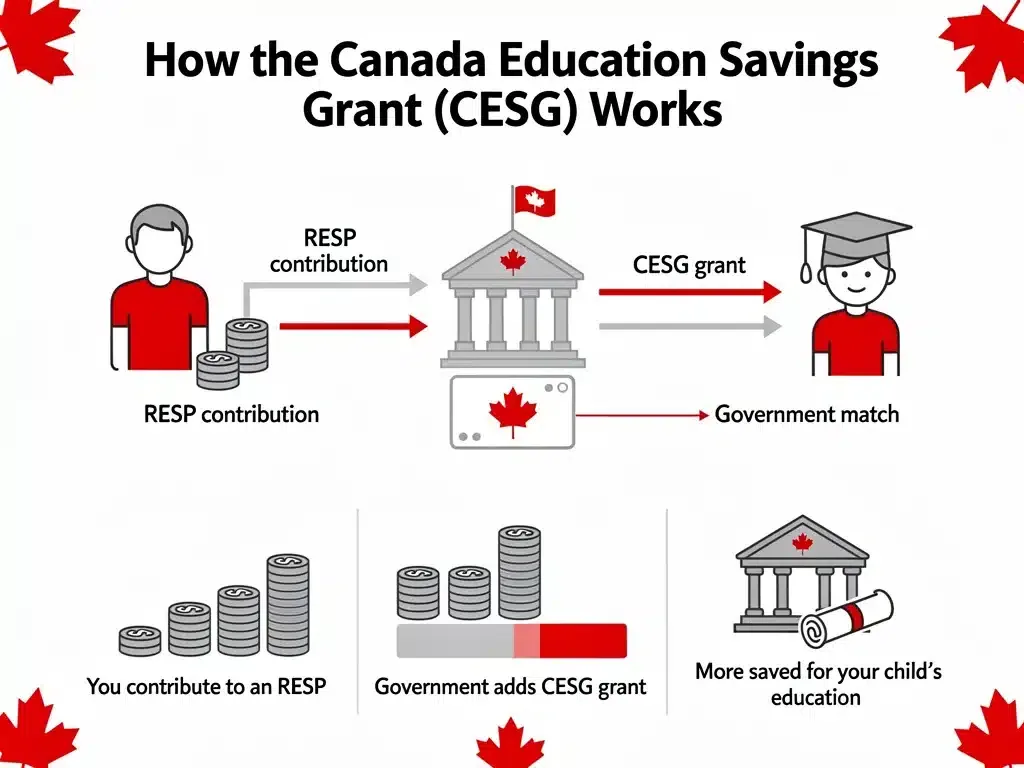
The Canada Education Savings Grant (CESG) is a program designed by the Canadian government to encourage families to save for a child’s post-secondary education through a Registered Education Savings Plan (RESP).
This grant provides a significant boost to RESP savings, making it an indispensable part of any sound financial plan for education.
Under the basic CESG, the government contributes 20 cents on every dollar saved in an RESP, up to a maximum of $500 per year per beneficiary.
To receive this maximum annual grant, a contribution of $2,500 is required, highlighting the importance of strategic RESP Contribution Strategies.
Over a child’s lifetime, the maximum CESG a beneficiary can receive is $7,200. This long-term benefit underscores the power of consistent contributions and well-executed RESP Contribution Strategies from an early age.
The $2,500 Annual Contribution Sweet Spot
Contributing $2,500 annually to an RESP is the optimal strategy for maximizing the basic CESG. This specific amount triggers the full $500 grant from the government, representing a guaranteed 20% return on that portion of your savings.
Families who consistently contribute $2,500 each year can quickly accumulate significant grant money, accelerating the growth of their child’s education fund. This consistent approach is central to effective RESP Contribution Strategies.
Missing a year’s $2,500 contribution means forfeiting that year’s potential $500 grant, which can only be carried forward and claimed in subsequent years, subject to certain limits. Therefore, timely and consistent contributions are paramount for maximizing the CESG.
Strategic Approaches to RESP Contributions
Developing effective RESP Contribution Strategies involves more than just depositing funds; it requires careful planning to optimize government grants and investment growth.
Understanding the nuances of contribution timing and carry-forward rules can significantly enhance your RESP’s potential.
One primary strategy is to front-load contributions if financially feasible, especially for younger children, to allow more time for investments to grow. However, even with smaller, consistent contributions, families can still benefit immensely from the CESG.
For those who cannot always meet the $2,500 annual target, understanding the carry-forward provisions is vital. Unused CESG entitlement can be carried forward, allowing you to catch up on missed grants in later years, albeit with specific annual limits.
Optimizing Carry-Forward CESG Entitlement
If you haven’t contributed $2,500 to your RESP every year, you may have unused CESG room. This carry-forward mechanism allows you to claim grants for previous years’ unused entitlements, up to a certain limit.
When making contributions to catch up on CESG, the government will apply the grant to both the current year’s entitlement and any carry-forward amounts.
This means you can potentially receive more than the standard $500 CESG in a single year, making it a powerful aspect of RESP Contribution Strategies.
The maximum CESG that can be received in one year, including carry-forward amounts, is typically $1,000 (requiring a $5,000 contribution). This can be a game-changer for families looking to accelerate their RESP savings, underscoring the flexibility within RESP Contribution Strategies.
The Importance of Early and Consistent Contributions
Starting RESP contributions early is one of the most powerful strategies for maximizing the benefits of the CESG and overall investment growth. The longer the money is invested, the more time it has to grow through compounding, significantly increasing the final education fund.
Consistent contributions, even if they are small monthly deposits that add up to $2,500 annually, ensure that you regularly trigger the CESG. This steady stream of government grants, combined with investment returns, creates a robust savings trajectory.
For example, contributing $208.33 each month will reach the $2,500 annual target, ensuring the maximum basic CESG. This disciplined approach is a cornerstone of effective RESP Contribution Strategies.
Compounding Returns and Grant Accumulation
The power of compounding is particularly evident in RESPs, where both your contributions and the government’s CESG grants grow over time. Early contributions benefit from a longer investment horizon, allowing returns to generate further returns.
Consider the combined effect of consistent $2,500 annual contributions and the $500 CESG.
Over 18 years, without even factoring in investment growth, you would have contributed $45,000 and received $9,000 in grants (if the $7,200 lifetime limit was reached earlier), totaling $54,000 before investment gains.
With a reasonable rate of return, this capital can grow substantially, making the dream of post-secondary education more attainable. This long-term perspective is fundamental to successful RESP Contribution Strategies.
Additional Grants and Considerations
Beyond the basic CESG, some Canadian families may be eligible for additional government grants, further enhancing their RESP savings. These grants are typically income-tested and designed to provide extra support to low and middle-income families.
The Additional CESG provides an extra 10% or 20% on the first $500 of annual RESP contributions, depending on the family’s net income. This means a low-income family contributing $500 could receive an extra $100 annually, on top of the basic $100.
Another significant grant is the Canada Learning Bond (CLB), which provides $500 into an RESP for eligible children born in 2004 or later, plus an additional $100 for each year of eligibility, up to a maximum of $2,000.
These grants, combined with strategic RESP Contribution Strategies, can make a substantial difference.
Provincial RESP Grants
Certain provinces also offer their own education savings grants, which can be combined with federal grants to further boost RESP savings. It is crucial for residents of these provinces to investigate their eligibility for these additional programs.
For instance, Quebec offers the Quebec Education Savings Incentive (QESI), which provides a refundable tax credit equivalent to 10% of annual RESP contributions, up to a maximum of $250 per year.
British Columbia also had the BC Training and Education Savings Grant (BCTESG), though it is currently not accepting new applications.
Staying informed about provincial grant programs is an essential part of comprehensive RESP Contribution Strategies. These grants can add thousands more to a child’s education fund over the years.
Choosing the Right RESP Investment Options
Selecting appropriate investment vehicles within your RESP is as critical as making timely contributions. The right investment strategy can significantly impact the growth of your education savings, aligning with your risk tolerance and time horizon.
Common RESP investment options include mutual funds, exchange-traded funds (ETFs), GICs, and individual stocks or bonds. Diversifying your portfolio across different asset classes can help mitigate risk and enhance potential returns.
For younger beneficiaries with a long investment horizon, a growth-oriented portfolio with a higher allocation to equities might be suitable. As the child approaches post-secondary education, gradually shifting towards more conservative investments can help protect accumulated savings.
Professional Guidance for RESP Investments
Navigating the complexities of RESP investments can be challenging, especially with varying market conditions and personal financial goals. Seeking advice from a qualified financial advisor can be invaluable in crafting a suitable investment strategy.
A financial advisor can help assess your risk profile, understand your time horizon, and recommend a diversified portfolio that aligns with your RESP Contribution Strategies. They can also help you stay on track with your goals and make adjustments as needed.
Their expertise can ensure that your RESP is not only benefiting from government grants but also growing effectively through smart investment choices. This holistic approach is key to long-term success in education savings.
Monitoring and Adjusting Your RESP Strategy
Once your RESP is established and contributions are being made, it’s important to regularly monitor its performance and adjust your strategy as circumstances change. Life events, market fluctuations, and policy updates can all impact your RESP’s effectiveness.
Reviewing your RESP statements annually allows you to track investment growth, confirm CESG receipts, and ensure you are on target to meet your savings goals. This proactive monitoring is a key component of robust RESP Contribution Strategies.
Consider adjusting your contribution amounts if your financial situation changes, or rebalancing your investment portfolio if market conditions shift significantly. Flexibility is crucial to maintaining an optimized RESP.
Adapting to Policy Changes and Market Trends
Government policies regarding RESPs and the CESG can evolve, impacting future contribution strategies. Staying informed about these potential changes is vital to ensure your plan remains optimized and compliant.
Similarly, understanding broader economic and market trends can help you make informed decisions about your RESP investments. For example, periods of high inflation might prompt a review of your portfolio’s ability to maintain purchasing power.
By regularly reviewing and adapting your RESP Contribution Strategies, you can ensure your child’s education fund remains robust and responsive to changing circumstances.
The Long-Term Impact of Maximized RESPs
The long-term impact of consistently maximizing your RESP contributions and CESG grants cannot be overstated. A well-funded RESP provides significant financial relief when your child is ready for post-secondary education, potentially reducing the need for student loans.
Beyond the financial benefits, a robust RESP provides peace of mind for parents, knowing they have adequately prepared for their child’s future. It empowers students to pursue their educational dreams without the immediate burden of substantial debt.
Ultimately, strategic RESP Contribution Strategies are an investment not just in education, but in a child’s future opportunities and success. It’s a testament to long-term financial planning and responsible parenting.
Empowering Future Generations
By leveraging the full potential of the CESG and making consistent $2,500 annual contributions, Canadian families are directly investing in the human capital of the next generation. This financial support can open doors to higher education, specialized training, and ultimately, greater career opportunities.
The funds accumulated in an RESP can cover tuition fees, books, living expenses, and other costs associated with post-secondary studies. This comprehensive support allows students to focus on their academic pursuits rather than financial strain.
These well-executed RESP Contribution Strategies truly empower children to achieve their full potential, contributing to a more educated and skilled workforce in Canada.
| Key Point | Brief Description |
|---|---|
| Max CESG Grant | Receive up to $500 annually with a $2,500 contribution. |
| Carry-Forward Rules | Claim unused CESG entitlement in subsequent years, up to $1,000 annually. |
| Early Contributions | Maximize compounding growth and overall grant accumulation. |
| Additional Grants | Explore eligibility for Additional CESG, CLB, and provincial grants. |
Frequently Asked Questions About RESP Contributions
What is the primary benefit of a $2,500 annual RESP contribution?▼Contributing $2,500 annually to an RESP allows you to maximize the basic Canada Education Savings Grant (CESG), securing the full $500 government contribution for that year. This 20% match significantly boosts your child’s education savings, making it a cornerstone of effective RESP Contribution Strategies for Maximizing the 2026 CESG Grant with a $2,500 Annual Contribution.
Can I still receive CESG if I miss a $2,500 contribution?▼Yes, any unused CESG entitlement can be carried forward to subsequent years. You can claim up to $1,000 in CESG in a single year (requiring a $5,000 contribution) by utilizing both current and carry-forward entitlements. This flexibility is crucial for RESP Contribution Strategies for Maximizing the 2026 CESG Grant with a $2,500 Annual Contribution, allowing catch-up on missed grants.
What other government grants are available for RESPs?▼Beyond the basic CESG, eligible families may qualify for the Additional CESG (income-tested) and the Canada Learning Bond (CLB). Some provinces, like Quebec with the QESI, also offer their own grants. These additional programs can further enhance RESP Contribution Strategies for Maximizing the 2026 CESG Grant with a $2,500 Annual Contribution.
Is early contribution truly important for RESP growth?▼Absolutely. Starting RESP contributions early allows for a longer period of compounding growth, where your initial investments and government grants generate further returns. This significantly increases the total value of the education fund over time, making it a critical element of RESP Contribution Strategies for Maximizing the 2026 CESG Grant with a $2,500 Annual Contribution.
How can I ensure my RESP investment strategy is optimal?▼To optimize your RESP investment strategy, consider your risk tolerance, time horizon, and diversification. Consulting a qualified financial advisor can provide tailored guidance, helping you select appropriate investment vehicles and ensure your RESP Contribution Strategies for Maximizing the 2026 CESG Grant with a $2,500 Annual Contribution are aligned with your financial goals.
Looking Ahead: Sustaining Education Savings Momentum
The commitment to effective RESP Contribution Strategies continues to be a cornerstone of Canadian family financial planning. As 2026 approaches, the focus remains on consistent contributions and leveraging all available government grants to secure a brighter educational future.
Families should prioritize regular reviews of their RESP accounts, ensuring they are on track to meet their savings goals and adapting to any changes in personal finances or government policies. The dynamic nature of financial planning necessitates this proactive approach.
By maintaining vigilance and adhering to well-defined RESP Contribution Strategies, Canadians can confidently build a substantial education fund, empowering the next generation to achieve their academic aspirations.