SSDI Substantial Gainful Activity Updates: $1,620 Limit in 2026
Advertisements
For Social Security Disability Insurance recipients, balancing the desire to earn income with the risk of losing monthly assistance is a delicate line to walk. Knowing exactly how much you can earn without triggering a review of your benefits is critical to protecting your financial stability.
Understanding the SSDI Substantial Gainful Activity framework—and its monthly threshold—is essential for anyone planning a return to work or managing part-time employment. Exceeding this figure can jeopardized your monthly checks, making income tracking an absolute priority.
(Note: While the draft references $1,620, the official SSA cap for non-blind beneficiaries in 2025 was $1,620, whereas the updated limit for 2026 is $1,690 per month.) Navigating these Social Security rules doesn't have to be overwhelming when you know how the program's earning thresholds and work incentives function.
Understanding the 2026 SGA Limit
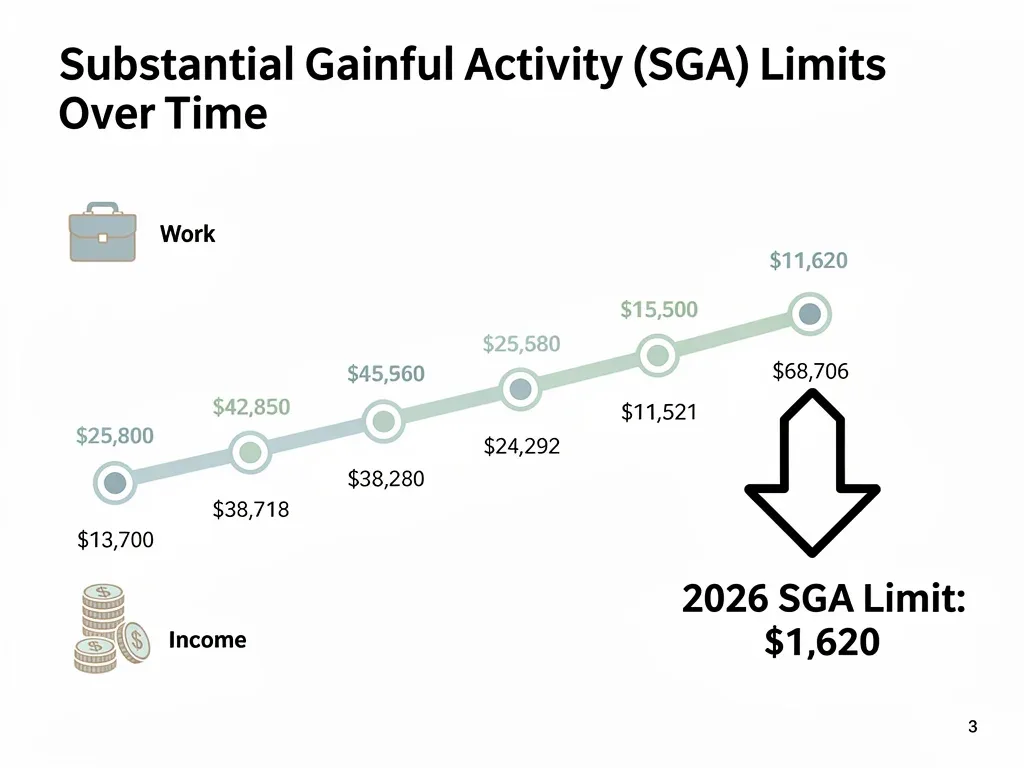
The Substantial Gainful Activity (SGA) limit is a key component of the Social Security Disability Insurance program, defining how much a beneficiary can earn monthly without their disability status being questioned. For 2026, this critical threshold has been set at $1,620 per month for non-blind individuals, a notable increase from previous years.
This updated limit is designed to account for inflation and cost-of-living adjustments, ensuring that the SGA threshold remains relevant to current economic realities. Beneficiaries must diligently track their earnings to stay below this amount if they wish to continue receiving their full SSDI benefits without review.
The SSA regularly reviews and adjusts the SGA limit to reflect economic changes and maintain the integrity of the disability program. These SSDI Substantial Gainful Activity Updates are vital for individuals seeking to re-enter the workforce or supplement their benefits through part-time employment.
What Constitutes Substantial Gainful Activity?
Substantial Gainful Activity refers to work activity that involves significant physical or mental activities, performed for pay or profit. The SSA uses the SGA limit to determine if an individual's work demonstrates an ability to engage in substantial work, which would indicate they are no longer disabled under their criteria.
The $1,620 limit for 2026 applies to gross monthly earnings, meaning before taxes and other deductions. It's important to note that certain impairment-related work expenses (IRWEs) can sometimes be deducted from gross earnings, potentially allowing a beneficiary to earn slightly more and still remain below the SGA limit.
Understanding what counts as SGA and how earnings are calculated is paramount for beneficiaries. Misinterpreting these rules can lead to benefit suspension or termination, making precise knowledge of these SSDI Substantial Gainful Activity Updates indispensable.
Gross monthly earnings are the primary factor in SGA determination.
Impairment-Related Work Expenses (IRWEs) can reduce countable income.
Work performed on a volunteer basis typically does not count as SGA.
Self-employment income calculations involve specific rules and deductions.
Impact of the $1,620 Limit on Beneficiaries
The new $1,620 monthly earnings limit for 2026 has direct and significant implications for SSDI beneficiaries who are working or considering returning to work. This adjustment provides a clearer financial boundary, allowing individuals to plan their employment strategies with greater certainty.
For many, this increased limit offers a slightly greater opportunity to earn income without jeopardizing their disability benefits, fostering a smoother transition back into the workforce. However, exceeding this limit can trigger a review of their disability status, potentially leading to a cessation of benefits.
Beneficiaries must therefore exercise caution and meticulous record-keeping regarding their earnings. These SSDI Substantial Gainful Activity Updates necessitate a proactive approach to financial planning and communication with the Social Security Administration.
Navigating the Trial Work Period (TWP)
The Trial Work Period (TWP) is a crucial provision designed to allow SSDI beneficiaries to test their ability to work without immediately losing benefits. During the TWP, beneficiaries can earn above the SGA limit for up to nine months within a 60-month period, and their benefits will continue.
For 2026, a month counts as a TWP month if gross earnings exceed $1,110. It is vital to distinguish the TWP threshold from the SGA limit; they serve different purposes within the SSDI program. Once the nine TWP months are used, the SGA limit becomes the primary determinant of benefit eligibility.
Understanding the interplay between the TWP and the SGA limit is critical for beneficiaries exploring employment. These SSDI Substantial Gainful Activity Updates emphasize the importance of strategic planning to maximize work opportunities while preserving benefits.
The Trial Work Period allows earning above SGA for nine months.
TWP months are counted when earnings exceed a specific threshold, currently $1,110.
Benefits continue during the TWP regardless of earnings amount.
After TWP, the SGA limit becomes strictly enforced for benefit eligibility.
Reporting Earnings to the SSA
Accurate and timely reporting of earnings to the Social Security Administration is a non-negotiable responsibility for all SSDI beneficiaries. Failure to report income correctly can lead to overpayments, which the SSA will seek to recover, or even benefit termination.
Beneficiaries should report all gross earnings from employment or self-employment monthly, even during the Trial Work Period. The SSA provides several methods for reporting, including mail, phone, or in-person at a local Social Security office.
Consistent and transparent communication with the SSA is the best defense against potential issues arising from these SSDI Substantial Gainful Activity Updates. Keeping detailed records of pay stubs and reported income is also highly advisable.
Methods for Reporting Income
The SSA offers various channels for beneficiaries to report their earnings, ensuring accessibility and convenience. These methods are designed to facilitate accurate and timely submissions, which are crucial for maintaining benefit eligibility and avoiding complications.
Many beneficiaries opt to mail copies of their pay stubs or self-employment ledgers directly to their local Social Security office. Another common method involves calling the SSA's toll-free number to provide verbal updates on monthly earnings. Online reporting options are also becoming more prevalent.
Regardless of the chosen method, beneficiaries should always request confirmation of their submission. This due diligence ensures that their earnings reports are officially recorded, thus helping them adhere to the latest SSDI Substantial Gainful Activity Updates.
Mail copies of pay stubs to your local SSA office.
Call the SSA's national toll-free number to report earnings.
Utilize any available online reporting tools provided by the SSA.
Always keep records of your reports and any confirmation received.
Exclusions and Deductions from Earnings
While the $1,620 SGA limit is a strict guideline, certain types of income and expenses can be excluded or deducted when determining countable earnings. Understanding these provisions can significantly impact a beneficiary's ability to work while retaining benefits.
Impairment-Related Work Expenses (IRWEs) are among the most important deductions. These are costs incurred by a beneficiary due to their disability that enable them to work, such as specialized transportation, medical devices, or personal attendant services. These expenses are deducted from gross earnings before the SGA limit is applied.
Other work incentives, like subsidies and special conditions, can also affect how earnings are calculated. Beneficiaries should explore all potential deductions and exclusions to maximize their work capacity under the new SSDI Substantial Gainful Activity Updates.
Impairment-Related Work Expenses (IRWEs)
IRWEs play a vital role in allowing beneficiaries to work without exceeding the SGA limit. These expenses must be directly related to the individual's disability and necessary for their work. Examples include wheelchairs, specialized computer equipment, or certain medications.
To claim IRWEs, beneficiaries must provide documentation, such as receipts, to the SSA. The expenses must be paid by the beneficiary and not reimbursed by another source. Proper documentation is key to ensuring these deductions are applied correctly.
The ability to deduct IRWEs offers considerable flexibility within the SSDI Substantial Gainful Activity Updates framework. It allows individuals with significant disability-related costs to earn more while still being considered below the SGA threshold, thereby promoting greater independence.
IRWEs are disability-related expenses essential for work.
Examples include specialized transportation, medical devices, and personal assistance.
Beneficiaries must pay for IRWEs themselves and provide documentation.
IRWEs are deducted from gross earnings before SGA calculation.
Work Incentives and Employment Support
The Social Security Administration offers various work incentives programs designed to support SSDI beneficiaries in their efforts to return to work. These programs are crucial for navigating the complexities of the SGA limit and ensuring a smooth transition back into employment.
Beyond the Trial Work Period and IRWEs, programs like the Plan to Achieve Self-Support (PASS) and the Ticket to Work program provide additional resources. These initiatives aim to help beneficiaries achieve financial independence while safeguarding their access to necessary benefits.
Staying informed about these work incentives is essential for any beneficiary considering employment. The SSDI Substantial Gainful Activity Updates are part of a broader system designed to encourage work while providing a safety net.
Ticket to Work Program
The Ticket to Work program is a voluntary program that provides SSDI beneficiaries with access to employment services, vocational rehabilitation, and other support. It allows individuals to receive free employment support services from providers such as Employment Networks (ENs) or State Vocational Rehabilitation (VR) agencies.
Participation in the Ticket to Work program can help protect beneficiaries from medical continuing disability reviews while they are actively pursuing employment goals. This offers a significant advantage for those concerned about their disability status being re-evaluated during their work efforts.
The Ticket to Work program is a valuable resource for beneficiaries seeking to leverage the new SSDI Substantial Gainful Activity Updates. It provides a structured pathway to employment with ongoing support and protection for benefits.
Ticket to Work is a voluntary program offering employment support.
It helps beneficiaries access services from Employment Networks or VR agencies.
Participation can protect against medical continuing disability reviews.
It aims to facilitate long-term financial independence for beneficiaries.
Planning for Future SSDI Substantial Gainful Activity Updates
The $1,620 monthly earnings limit for 2026 is a current adjustment, but beneficiaries should anticipate further changes in the future. The SSA regularly reviews economic data and adjusts its thresholds to account for inflation and cost-of-living increases.
Staying proactive in monitoring SSA announcements and official publications is crucial for long-term financial planning. These ongoing adjustments mean that what is true today regarding SSDI Substantial Gainful Activity Updates may evolve in subsequent years.
Beneficiaries should consider consulting with benefits counselors or financial advisors specializing in disability benefits. These professionals can help interpret complex regulations and develop strategies that align with future SGA adjustments.

Resources for Beneficiaries
Access to reliable information and support is paramount for navigating the intricacies of SSDI benefits and work incentives. The Social Security Administration's official website is the primary source for accurate and up-to-date information on all programs and policies.
Local Social Security offices also offer in-person assistance, providing personalized guidance on reporting earnings, understanding work incentives, and addressing specific case concerns. Community-based organizations and non-profits often provide free benefits counseling services to disabled individuals.
Utilizing these resources can empower beneficiaries to make informed decisions and ensure compliance with all SSDI Substantial Gainful Activity Updates. Proactive engagement with available support systems is key to successful benefit management.
The official Social Security Administration website is a primary resource.
Local SSA offices provide in-person assistance and guidance.
Benefits counselors and non-profit organizations offer specialized support.
Staying informed through official channels is critical for compliance.
The Broader Economic Context of SGA Limits
The setting of the $1,620 SGA limit for 2026 is not an isolated decision; it is intricately linked to broader economic conditions and policy objectives. These adjustments reflect the SSA's commitment to maintaining the purchasing power of disability benefits while adapting to national economic trends.
Inflation rates, wage growth, and overall economic stability directly influence the SSA's annual review processes for disability thresholds. The goal is to ensure that the SGA limit remains fair and relevant, preventing it from becoming an unintended barrier to work for beneficiaries.
Understanding this larger economic context provides a deeper appreciation for why these SSDI Substantial Gainful Activity Updates occur and their long-term implications for the disability community. It underscores the dynamic nature of social security policy.
Policy Objectives Behind SGA Adjustments
The SSA's policy objectives for adjusting the SGA limit are multi-faceted, balancing financial support with work encouragement. The administration aims to provide a safety net for those unable to work due to disability while simultaneously offering pathways for those who can work to re-enter the labor force.
These adjustments also consider the financial solvency of the Social Security trust funds. By setting appropriate SGA limits, the SSA seeks to manage expenditures responsibly while fulfilling its mandate to support beneficiaries. It's a delicate balance designed to serve both individual and systemic needs.
The ongoing revisions to the SGA limit, including the latest SSDI Substantial Gainful Activity Updates, are a testament to the SSA's adaptive approach. They reflect a continuous effort to refine policies that serve the best interests of beneficiaries within a sustainable framework.
Key Point | Brief Description |
|---|---|
2026 SGA Limit | Monthly earnings limit for non-blind SSDI beneficiaries set at $1,620. |
Trial Work Period (TWP) | Allows beneficiaries to earn above SGA for 9 months without losing benefits. |
Reporting Earnings | Mandatory and timely reporting of all gross earnings to the SSA. |
Work Incentives | Programs like Ticket to Work and IRWEs support return to employment. |
Frequently Asked Questions About SSDI Substantial Gainful Activity
What is the new Substantial Gainful Activity (SGA) limit for 2026?▼
For 2026, the Substantial Gainful Activity (SGA) limit for non-blind SSDI beneficiaries is set at $1,620 per month. This amount represents the maximum gross earnings an individual can have without their disability status being re-evaluated by the Social Security Administration.
How do these SSDI Substantial Gainful Activity Updates affect my benefits?▼
If your gross monthly earnings exceed the $1,620 SGA limit after any applicable deductions, the SSA may determine that you are engaging in substantial gainful activity, which could lead to a review or cessation of your SSDI benefits. Proper tracking and reporting are crucial.
Can I work and still receive SSDI benefits?▼
Yes, you can work and receive SSDI benefits, provided your earnings do not exceed the SGA limit or you are within a Trial Work Period. The SSA offers various work incentives to support beneficiaries in their efforts to return to employment without losing vital benefits.
What is the Trial Work Period (TWP) and how does it relate to SGA?▼
The Trial Work Period allows SSDI beneficiaries to test their ability to work for up to nine months (within a 60-month period) where they can earn above the SGA limit without affecting their benefits. Once the TWP is completed, the SGA limit of $1,620 for 2026 becomes critical.
What should I do to comply with these new updates?▼
To comply with the new SSDI Substantial Gainful Activity Updates, you must accurately and timely report all your gross monthly earnings to the SSA. Keep detailed records of your income and consider utilizing resources like benefits counselors to ensure you understand all regulations and work incentives.
Looking Ahead: Navigating Future Changes
The latest SSDI Substantial Gainful Activity Updates underscores the dynamic nature of disability benefits. Beneficiaries must remain vigilant and informed about these adjustments, as they directly impact their financial stability and work opportunities. Future revisions are inevitable, driven by economic shifts and policy considerations.
It is imperative for individuals receiving SSDI to proactively engage with SSA resources, understand work incentives, and meticulously manage their earnings. This forward-looking approach will ensure compliance and help beneficiaries effectively plan for their financial future.
Staying abreast of these changes, particularly the SSDI Substantial Gainful Activity Updates, is not merely about adherence to rules but about strategically maximizing personal well-being within the framework of available support. The path forward involves continuous learning and proactive engagement.