Caregiver Benefits Canada 2026: Eligibility & 15-Week Support
Advertisements

Latest developments on Caregiver Benefits in Canada 2026: A Detailed Look at Eligibility and How to Claim Up to 15 Weeks of Support, with key facts, verified sources and what readers need to monitor next in Canada, presented clearly.
Caregiver Benefits in Canada 2026: A Detailed Look at Eligibility and How to Claim Up to 15 Weeks of Support is shaping today’s agenda with new details released by officials and industry sources. This update prioritizes what changed, why it matters and what to watch next, in a straightforward news format.
Understanding Caregiver Benefits in Canada 2026
The Canadian government is continually refining its support systems for caregivers, acknowledging their indispensable role in society. As 2026 approaches, several key updates and clarifications are emerging regarding the financial assistance available.
These benefits are designed to alleviate some of the financial burdens faced by individuals who must take time away from work to care for a critically ill or injured family member. Understanding these provisions is crucial for eligible Canadians planning their caregiving responsibilities.
The focus remains on ensuring that those who dedicate their time to caregiving can do so without facing undue financial hardship. The upcoming changes aim to streamline access and enhance the overall support structure for caregivers across the nation.
Eligibility Criteria for 15 Weeks of Support
To qualify for the extended 15 weeks of support under the Caregiver Benefits in Canada 2026, specific criteria must be met, primarily revolving around the care recipient’s health status and the caregiver’s employment history. These requirements ensure that the benefits reach those most in need.
The care recipient must be critically ill or injured, requiring significant care or support, as certified by a medical professional. This medical certification is a cornerstone of the eligibility process, confirming the necessity of the caregiver’s presence.
Caregivers themselves must have accumulated a certain number of insurable hours of employment in the 52 weeks leading up to their claim. This employment insurance (EI) component is fundamental to accessing the financial aid provided by these benefits.
Who Qualifies for Critical Illness Benefits
The definition of ‘critically ill or injured’ is precise, focusing on a significant change in the care recipient’s baseline state of health. This change must pose a risk to their life and require the support of one or more caregivers.
Medical practitioners play a vital role in certifying this condition, providing the necessary documentation for the claim. Their assessment forms the basis for determining eligibility for the Caregiver Benefits in Canada 2026.
The benefits are not restricted by age or relationship, meaning both adult and child care recipients can qualify, provided their medical needs align with the program’s definitions.
- Care recipient must be certified as critically ill or injured by a medical doctor.
- Significant risk to life due to illness or injury.
- Requires care or support from one or more caregivers.
- No age restriction for the care recipient.
Caregiver Employment Requirements
Caregivers must demonstrate a recent work history to be eligible for the Caregiver Benefits in Canada 2026. This typically involves accumulating 600 insurable hours of employment during the qualifying period.
The qualifying period is usually the 52 weeks immediately before the start of the claim, or since the start of a previous EI claim, whichever is shorter. This ensures that the benefits are tied to recent workforce participation.
Self-employed individuals may also be eligible if they have opted into the EI program’s special benefits for the self-employed and meet the earnings threshold. This broadens the scope of who can access these crucial supports.
- Accumulated 600 insurable hours in the past 52 weeks.
- Employed individuals must have paid EI premiums.
- Self-employed individuals must have opted into EI special benefits.
- Must experience a reduction in regular weekly earnings by more than 40%.
How to Claim Your Caregiver Benefits
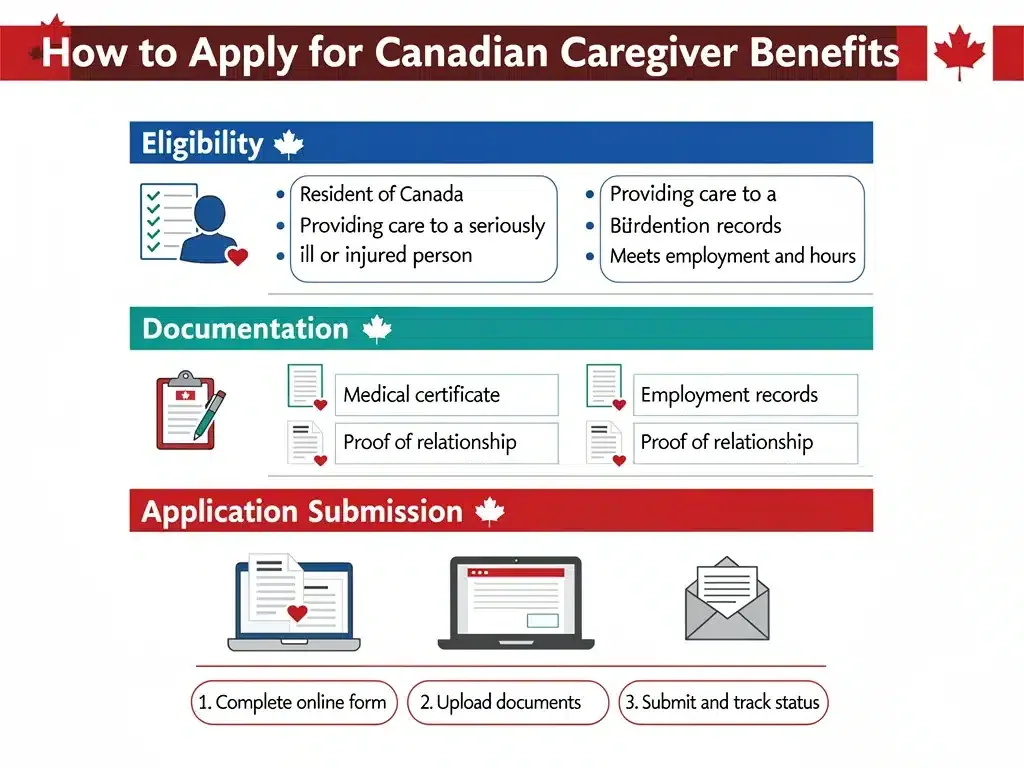
Claiming Caregiver Benefits in Canada 2026 involves a structured application process that requires attention to detail and timely submission of documentation. Starting early and gathering all necessary information is key to a smooth application.
The primary step is to apply online through the Service Canada website, which guides applicants through a series of questions and required uploads. This digital approach aims to simplify the process for caregivers.
Medical certificates from the care recipient’s doctor are indispensable; without them, the application cannot proceed. Ensuring these documents are accurately completed and submitted promptly is vital for receiving the Caregiver Benefits in Canada 2026.
The Online Application Process
Applying for Caregiver Benefits in Canada 2026 online is the most efficient method, allowing for direct submission of all required forms and supporting documents. The Service Canada portal is designed for user-friendliness.
Applicants will need their Social Insurance Number (SIN), banking information for direct deposit, and the medical certificate from the care recipient’s doctor. Having these details ready beforehand expedites the process.
It’s crucial to complete all sections accurately to avoid delays in processing. Any discrepancies or missing information can lead to significant setbacks in receiving the much-needed Caregiver Benefits in Canada 2026.
Required Documentation and Deadlines
Beyond the online application, several documents are essential for a successful claim. The medical certificate, completed by a medical doctor or nurse practitioner, is paramount, detailing the critical illness or injury.
Caregivers also need to provide their Record of Employment (ROE) from their employer, which confirms their insurable hours and separation from work. For self-employed individuals, proof of income and EI premium payments is required.
While there isn’t a strict deadline for applying, it is recommended to submit the application as soon as the need for caregiving arises. Benefits cannot be paid for periods more than four weeks before the date the application was received, emphasizing the importance of timely action for Caregiver Benefits in Canada 2026.
Duration and Flexibility of Caregiver Support
The provision of up to 15 weeks of support offers significant flexibility for caregivers, allowing them to manage their responsibilities over an extended period. This duration is designed to accommodate various caregiving needs and situations.
Caregivers can choose to take these weeks consecutively or intermittently, depending on the evolving health needs of the care recipient. This adaptability is a crucial feature of the Caregiver Benefits in Canada 2026 program.
Understanding how to best utilize these weeks can maximize the benefit for both the caregiver and the care recipient, ensuring sustained support during critical times. Strategic planning is encouraged to optimize the use of these weeks.
Consecutive vs. Intermittent Claims
The option to claim benefits consecutively or intermittently provides caregivers with much-needed flexibility. Consecutive claims are suitable for situations requiring continuous, intensive care over several weeks.
Intermittent claims, on the other hand, allow caregivers to take time off as needed, perhaps for appointments, specific treatments, or periods of increased care requirements. This can be spread over a 52-week period.
This flexibility ensures that the Caregiver Benefits in Canada 2026 can be tailored to the specific and often unpredictable nature of caregiving. It empowers caregivers to respond effectively to the changing needs of their loved ones.
Maximizing Your 15 Weeks of Support
To maximize the 15 weeks of support, caregivers should communicate openly with their care recipient’s medical team to anticipate future needs. This foresight can help in planning when to best utilize the benefit weeks.
Considering the option of sharing benefits with other eligible family members can also extend the overall period of care provided. Multiple caregivers can share the 15 weeks, allowing for comprehensive support.
Consulting with Service Canada representatives can provide personalized advice on how to best structure your claim to optimize the Caregiver Benefits in Canada 2026. They can offer guidance on specific scenarios and eligibility nuances.
Impact of Caregiver Benefits on Canadian Families
The availability of Caregiver Benefits in Canada 2026 has a profound impact on Canadian families, offering a critical financial lifeline during challenging times. These benefits help mitigate the economic strain associated with caregiving responsibilities.
Families can experience reduced stress and improved well-being knowing that financial support is available while they care for a loved one. This allows caregivers to focus more on the care recipient’s needs rather than solely on lost income.
The program reinforces the societal value of caregiving, acknowledging the unpaid labour and emotional toll it often entails. It represents a tangible commitment to supporting Canadian families in their most vulnerable moments.
Financial Relief and Stability
For many families, the Caregiver Benefits in Canada 2026 provide essential financial relief, covering a portion of lost wages. This stability is crucial, as caregiving often requires a significant reduction or complete cessation of work.
The benefits help maintain household incomes, preventing financial hardship and allowing families to cover essential expenses. This financial buffer can make a substantial difference in a family’s ability to cope.
By offering this support, the government helps ensure that caregivers do not have to choose between their loved one’s well-being and their own financial security. This is a core objective of the Caregiver Benefits in Canada 2026.
Promoting Caregiver Well-being
Beyond the financial aspect, the Caregiver Benefits in Canada 2026 contribute significantly to the overall well-being of caregivers. Knowing that there is official support can reduce psychological stress and burnout.
The ability to take time off without complete financial devastation allows caregivers to dedicate their full attention to their loved ones, fostering a more nurturing and effective care environment.
This recognition and support can also encourage more individuals to step into caregiving roles, knowing that they will not be entirely alone in their efforts. It strengthens the caregiving ecosystem within Canada.
Anticipated Changes and Future Outlook 2026
As 2026 approaches, stakeholders and policymakers continue to evaluate the effectiveness and reach of caregiver support programs. Anticipated changes aim to further enhance accessibility and responsiveness to caregivers’ needs.
Discussions are ongoing regarding potential expansions of eligibility criteria or adjustments to benefit durations, reflecting a dynamic policy landscape. These considerations are part of a broader effort to improve the Caregiver Benefits in Canada 2026.
The government’s commitment to supporting caregivers is expected to remain strong, with future iterations of the program likely to incorporate feedback from caregivers and healthcare professionals. Continuous improvement is a key goal.

Potential Policy Adjustments
Several areas are under review for potential policy adjustments, including the definition of ‘family member’ and the types of illnesses that qualify for critical care benefits. These changes could broaden the scope of the Caregiver Benefits in Canada 2026.
There is also ongoing discussion about simplifying the application process and reducing administrative burdens for caregivers. Streamlining these procedures would make the benefits more accessible to those who need them most.
Any proposed adjustments will undergo thorough consultation processes, involving caregiver advocacy groups and medical professionals, to ensure they are effective and equitable. Transparency will be key in these developments.
Long-Term Vision for Caregiving Support
The long-term vision for caregiving support in Canada extends beyond financial benefits, encompassing a holistic approach to caregiver well-being. This includes access to resources, respite care, and community support networks.
The Caregiver Benefits in Canada 2026 are a crucial component of this broader strategy, providing a foundational layer of financial security. However, they are part of a larger ecosystem of support.
Future initiatives may focus on integrating health and social services to create a more seamless support system for caregivers, ensuring they receive comprehensive assistance. This integrated approach is vital for sustainable caregiving.
Resources and Support for Caregivers
Beyond the direct financial aid provided by the Caregiver Benefits in Canada 2026, a wealth of resources and support networks exist for caregivers across the country. These resources offer practical advice, emotional support, and community connections.
Organizations dedicated to caregiving provide invaluable information on navigating the healthcare system, managing care recipient needs, and accessing local services. These groups are often the first point of contact for many caregivers.
Connecting with other caregivers through support groups or online forums can also provide a sense of community and shared experience, reducing feelings of isolation. This peer support is a critical component of caregiver resilience.
Government and Non-Profit Organizations
Service Canada remains the primary point of contact for information regarding the Caregiver Benefits in Canada 2026, offering detailed guides and direct assistance with applications. Their website is an essential resource.
Numerous non-profit organizations, such as the Canadian Caregiver Coalition and provincial caregiver associations, offer extensive support services. These groups advocate for caregiver rights and provide practical tools and resources.
These organizations often host workshops, webinars, and events tailored to caregiver needs, covering topics from legal and financial planning to self-care strategies. Leveraging these resources can significantly enhance the caregiving journey.
Community and Peer Support
Community support groups offer a safe space for caregivers to share their experiences, challenges, and successes with others facing similar situations. These groups can be found in local community centers, hospitals, or online platforms.
Peer support can be incredibly validating, helping caregivers realize they are not alone in their journey. The shared wisdom and emotional encouragement gained from these interactions are invaluable.
Many online forums and social media groups are also dedicated to Canadian caregivers, providing a convenient way to connect and seek advice. These digital communities extend the reach of support beyond geographical boundaries, further enhancing the impact of Caregiver Benefits in Canada 2026.
Preparing for Caregiving Responsibilities
Preparing for caregiving responsibilities involves more than just understanding the financial benefits; it requires emotional, logistical, and practical planning. Proactive preparation can significantly ease the transition into a caregiving role.
This includes familiarizing oneself with the care recipient’s medical needs, understanding their daily routine, and setting up a support system. Early planning helps in managing the demands of caregiving more effectively.
Having candid conversations with family members about shared responsibilities and expectations can also prevent misunderstandings and ensure a coordinated approach to care. This preparation complements the support offered by Caregiver Benefits in Canada 2026.
Logistical and Emotional Preparation
Logistically, caregivers should consider aspects like home modifications, transportation needs, and medication management. Creating a detailed care plan can help organize these various elements effectively.
Emotionally, preparing for caregiving involves acknowledging the potential challenges, seeking support from mental health professionals if needed, and practicing self-care. Caregiving can be demanding, and emotional resilience is key.
Understanding that it’s acceptable to ask for help and delegate tasks is crucial for preventing burnout. The Caregiver Benefits in Canada 2026 aim to support this balance, but personal preparation is equally important.
Financial Planning and Legal Considerations
Beyond the Caregiver Benefits in Canada 2026, comprehensive financial planning is vital. This includes reviewing personal budgets, understanding potential lost income, and exploring other available financial assistance programs.
Legal considerations, such as power of attorney, advance care directives, and wills, should also be addressed to ensure the care recipient’s wishes are respected and legal matters are in order. Consulting with a legal professional is advisable.
These preparations, combined with the financial support from caregiver benefits, create a robust framework for managing the complexities of caregiving. Being well-informed and prepared is the best approach.
| Key Point | Brief Description |
|---|---|
| Eligibility | Caregiver and recipient must meet specific medical and employment criteria. |
| Benefit Duration | Up to 15 weeks of financial support available for eligible caregivers. |
| Claim Process | Online application via Service Canada with required medical certification and ROE. |
| Flexibility | Benefits can be claimed consecutively or intermittently over a 52-week period. |
Frequently Asked Questions About Caregiver Benefits
What exactly are the Caregiver Benefits in Canada 2026?▼The Caregiver Benefits in Canada 2026 refer to specific financial support programs under Employment Insurance. They provide up to 15 weeks of income replacement for eligible individuals who need to take time off work to care for a critically ill or injured family member, helping to ease financial strain during challenging times.
Who is considered a critically ill or injured family member?▼A critically ill or injured family member is someone whose life is at risk due to illness or injury, and whose health has significantly changed. A medical doctor or nurse practitioner must certify this condition, stating that the person requires care or support from one or more caregivers.
Can multiple family members share the 15 weeks of benefits?▼Yes, multiple eligible family members can share the 15 weeks of Caregiver Benefits in Canada 2026. This allows for a more flexible and comprehensive care plan, ensuring continuous support for the critically ill or injured individual. Each caregiver must meet their own eligibility requirements.
What if I am self-employed; can I still claim these benefits?▼Self-employed individuals can claim Caregiver Benefits in Canada 2026 if they have opted into the Employment Insurance (EI) program’s special benefits for the self-employed. They must also meet specific earnings thresholds and other eligibility criteria similar to employed individuals, including having paid EI premiums.
How quickly can I expect to receive my benefits after applying?▼After submitting a complete application for Caregiver Benefits in Canada 2026, Service Canada aims to process claims within 28 days. Delays can occur if information is missing or incorrect, so ensuring all documentation is accurate and submitted promptly is crucial to expedite the process.
Looking Ahead: Sustaining Caregiving Support
The continued evolution of Caregiver Benefits in Canada 2026 underscores a national commitment to supporting those who provide essential care. These benefits are more than financial aid; they represent recognition of the profound dedication and sacrifice inherent in caregiving.
As we move closer to 2026, the focus remains on optimizing these programs to ensure they are accessible, flexible, and truly impactful for Canadian families. Future policy discussions will undoubtedly center on enhancing the overall caregiving ecosystem.
Caregivers should stay informed about ongoing developments and leverage available resources to maximize their support. The Caregiver Benefits in Canada 2026 are a vital component of a broader strategy to foster a resilient and compassionate society.
The government’s commitment to supporting caregivers is expected to remain strong, with future iterations of the program likely to incorporate feedback from caregivers and healthcare professionals. Continuous improvement is a key goal.
Potential Policy Adjustments
Several areas are under review for potential policy adjustments, including the definition of ‘family member’ and the types of illnesses that qualify for critical care benefits. These changes could broaden the scope of the Caregiver Benefits in Canada 2026.
There is also ongoing discussion about simplifying the application process and reducing administrative burdens for caregivers. Streamlining these procedures would make the benefits more accessible to those who need them most.
Any proposed adjustments will undergo thorough consultation processes, involving caregiver advocacy groups and medical professionals, to ensure they are effective and equitable. Transparency will be key in these developments.
Long-Term Vision for Caregiving Support
The long-term vision for caregiving support in Canada extends beyond financial benefits, encompassing a holistic approach to caregiver well-being. This includes access to resources, respite care, and community support networks.
The Caregiver Benefits in Canada 2026 are a crucial component of this broader strategy, providing a foundational layer of financial security. However, they are part of a larger ecosystem of support.
Future initiatives may focus on integrating health and social services to create a more seamless support system for caregivers, ensuring they receive comprehensive assistance. This integrated approach is vital for sustainable caregiving.
Resources and Support for Caregivers
Beyond the direct financial aid provided by the Caregiver Benefits in Canada 2026, a wealth of resources and support networks exist for caregivers across the country. These resources offer practical advice, emotional support, and community connections.
Organizations dedicated to caregiving provide invaluable information on navigating the healthcare system, managing care recipient needs, and accessing local services. These groups are often the first point of contact for many caregivers.
Connecting with other caregivers through support groups or online forums can also provide a sense of community and shared experience, reducing feelings of isolation. This peer support is a critical component of caregiver resilience.
Government and Non-Profit Organizations
Service Canada remains the primary point of contact for information regarding the Caregiver Benefits in Canada 2026, offering detailed guides and direct assistance with applications. Their website is an essential resource.
Numerous non-profit organizations, such as the Canadian Caregiver Coalition and provincial caregiver associations, offer extensive support services. These groups advocate for caregiver rights and provide practical tools and resources.
These organizations often host workshops, webinars, and events tailored to caregiver needs, covering topics from legal and financial planning to self-care strategies. Leveraging these resources can significantly enhance the caregiving journey.
Community and Peer Support
Community support groups offer a safe space for caregivers to share their experiences, challenges, and successes with others facing similar situations. These groups can be found in local community centers, hospitals, or online platforms.
Peer support can be incredibly validating, helping caregivers realize they are not alone in their journey. The shared wisdom and emotional encouragement gained from these interactions are invaluable.
Many online forums and social media groups are also dedicated to Canadian caregivers, providing a convenient way to connect and seek advice. These digital communities extend the reach of support beyond geographical boundaries, further enhancing the impact of Caregiver Benefits in Canada 2026.
Preparing for Caregiving Responsibilities
Preparing for caregiving responsibilities involves more than just understanding the financial benefits; it requires emotional, logistical, and practical planning. Proactive preparation can significantly ease the transition into a caregiving role.
This includes familiarizing oneself with the care recipient’s medical needs, understanding their daily routine, and setting up a support system. Early planning helps in managing the demands of caregiving more effectively.
Having candid conversations with family members about shared responsibilities and expectations can also prevent misunderstandings and ensure a coordinated approach to care. This preparation complements the support offered by Caregiver Benefits in Canada 2026.
Logistical and Emotional Preparation
Logistically, caregivers should consider aspects like home modifications, transportation needs, and medication management. Creating a detailed care plan can help organize these various elements effectively.
Emotionally, preparing for caregiving involves acknowledging the potential challenges, seeking support from mental health professionals if needed, and practicing self-care. Caregiving can be demanding, and emotional resilience is key.
Understanding that it’s acceptable to ask for help and delegate tasks is crucial for preventing burnout. The Caregiver Benefits in Canada 2026 aim to support this balance, but personal preparation is equally important.
Financial Planning and Legal Considerations
Beyond the Caregiver Benefits in Canada 2026, comprehensive financial planning is vital. This includes reviewing personal budgets, understanding potential lost income, and exploring other available financial assistance programs.
Legal considerations, such as power of attorney, advance care directives, and wills, should also be addressed to ensure the care recipient’s wishes are respected and legal matters are in order. Consulting with a legal professional is advisable.
These preparations, combined with the financial support from caregiver benefits, create a robust framework for managing the complexities of caregiving. Being well-informed and prepared is the best approach.
| Key Point | Brief Description |
|---|---|
| Eligibility | Caregiver and recipient must meet specific medical and employment criteria. |
| Benefit Duration | Up to 15 weeks of financial support available for eligible caregivers. |
| Claim Process | Online application via Service Canada with required medical certification and ROE. |
| Flexibility | Benefits can be claimed consecutively or intermittently over a 52-week period. |
Frequently Asked Questions About Caregiver Benefits
What exactly are the Caregiver Benefits in Canada 2026?▼The Caregiver Benefits in Canada 2026 refer to specific financial support programs under Employment Insurance. They provide up to 15 weeks of income replacement for eligible individuals who need to take time off work to care for a critically ill or injured family member, helping to ease financial strain during challenging times.
Who is considered a critically ill or injured family member?▼A critically ill or injured family member is someone whose life is at risk due to illness or injury, and whose health has significantly changed. A medical doctor or nurse practitioner must certify this condition, stating that the person requires care or support from one or more caregivers.
Can multiple family members share the 15 weeks of benefits?▼Yes, multiple eligible family members can share the 15 weeks of Caregiver Benefits in Canada 2026. This allows for a more flexible and comprehensive care plan, ensuring continuous support for the critically ill or injured individual. Each caregiver must meet their own eligibility requirements.
What if I am self-employed; can I still claim these benefits?▼Self-employed individuals can claim Caregiver Benefits in Canada 2026 if they have opted into the Employment Insurance (EI) program’s special benefits for the self-employed. They must also meet specific earnings thresholds and other eligibility criteria similar to employed individuals, including having paid EI premiums.
How quickly can I expect to receive my benefits after applying?▼After submitting a complete application for Caregiver Benefits in Canada 2026, Service Canada aims to process claims within 28 days. Delays can occur if information is missing or incorrect, so ensuring all documentation is accurate and submitted promptly is crucial to expedite the process.
Looking Ahead: Sustaining Caregiving Support
The continued evolution of Caregiver Benefits in Canada 2026 underscores a national commitment to supporting those who provide essential care. These benefits are more than financial aid; they represent recognition of the profound dedication and sacrifice inherent in caregiving.
As we move closer to 2026, the focus remains on optimizing these programs to ensure they are accessible, flexible, and truly impactful for Canadian families. Future policy discussions will undoubtedly center on enhancing the overall caregiving ecosystem.
Caregivers should stay informed about ongoing developments and leverage available resources to maximize their support. The Caregiver Benefits in Canada 2026 are a vital component of a broader strategy to foster a resilient and compassionate society.