2026 Social Security COLA: Benefit Payout Changes Ahead
Advertisements
Will your monthly benefit keep up with the real cost of living? The upcoming 2026 Social Security COLA directly shapes how millions of retirees, disabled workers, and families adjust their household budgets to stay ahead of persistent inflation.
With updated Cost-of-Living Adjustments rolling out, understanding your revised payout amount is critical for protecting your personal purchasing power. Official parameters—from adjusted base rates to shifting Medicare premium deductions—will determine the true net gain landing in your bank account.
Beyond the raw numbers, strategic planning is essential to ensure your ongoing annuity checks cover medical bills, housing, and everyday necessities. Here is everything you need to know about the latest benefit rates and how to maximize your retirement income.
Understanding the Cost-of-Living Adjustment (COLA) Mechanism
The Cost-of-Living Adjustment, or COLA, is a vital component of the Social Security program, designed to protect the purchasing power of benefits. It ensures that inflation does not erode the value of monthly payments over time, a crucial consideration for long-term financial stability.
Each year, the Social Security Administration (SSA) announces the COLA for the following year, typically in October. This adjustment is based on changes in the Consumer Price Index for Urban Wage Earners and Clerical Workers (CPI-W), a key economic indicator.
The calculation method involves comparing the average CPI-W for the third quarter of the current year with the average for the third quarter of the previous year. Any increase in the CPI-W translates into a COLA, which then directly affects 2026 Social Security COLA for millions.
The Role of Inflation in COLA Determination
Inflation plays a direct and significant role in determining the annual COLA. When the cost of goods and services rises, the CPI-W reflects these increases, prompting a higher COLA to maintain beneficiaries' living standards.
Conversely, periods of low inflation or deflation can result in minimal or no COLA. This sensitivity to economic conditions makes the COLA a dynamic and often unpredictable factor in retirement planning, directly influencing 2026 Social Security COLA.
The 2026 Social Security COLA adjustment changes your monthly benefit payout based on the broader economic landscape. Understanding these economic forces is key to anticipating future benefit levels.
Factors Influencing the 2026 Social Security COLA Adjustment
Several economic factors are currently at play that will ultimately determine the 2026 Social Security COLA adjustment. These include inflation trends, wage growth, and broader economic stability, all of which directly impact the CPI-W calculation.
Current projections and expert analyses suggest a nuanced economic environment leading up to the 2026 determination. Supply chain dynamics, global economic shifts, and domestic policy decisions will all contribute to the inflationary pressures observed.
Monitoring these indicators closely provides the best insight into 2026 Social Security COLA. The interplay of these forces creates a complex picture for forecasting benefit increases.
Economic Indicators to Watch for the 2026 COLA
Consumer Price Index for Urban Wage Earners and Clerical Workers (CPI-W): This is the primary index used to calculate the COLA. Tracking its monthly changes provides the most direct forecast.
Energy Prices: Fluctuations in oil and gas prices significantly impact the CPI-W, as energy costs are a major component of household budgets.
Food Costs: Changes in food prices, another essential household expense, also heavily influence the CPI-W and, consequently, the COLA.
Wage Growth: While not directly used in the COLA formula, strong wage growth can indicate broader inflationary pressures that might translate into a higher CPI-W.
Analysts are closely observing these economic data points to formulate their predictions for the 2026 COLA. The trajectory of inflation in the coming months will be particularly crucial in shaping expectations for 2026 Social Security COLA.
Projected Impact on Monthly Benefit Payouts
Forecasting the exact percentage of the 2026 Social Security COLA adjustment is challenging, but projections provide a range of possibilities for beneficiaries. Even a small percentage increase can translate into a significant difference in monthly income over time.
For individuals currently receiving Social Security benefits, any COLA increase will be directly applied to their monthly check. This adjustment helps maintain their purchasing power in the face of rising living costs, which is especially critical for those on fixed incomes.
The impact of 2026 Social Security COLA extends beyond just the dollar amount; it influences budgeting, financial planning, and the overall quality of life for millions. Beneficiaries must understand how these adjustments are calculated.
How Different Scenarios Affect Your Benefits
A modest COLA, perhaps in the 1-2% range, would provide a slight boost to monthly benefits, helping to offset minor inflationary pressures. For someone receiving an average benefit, this could mean an extra $20-$40 per month.
A higher COLA, potentially in the 3-4% range, would offer a more substantial increase, providing greater relief against significant inflation. This scenario would lead to more noticeable changes in monthly payouts, directly affecting 2026 Social Security COLA.
Beneficiaries should consider how various COLA percentages might impact their personal financial situation. This proactive approach allows for better preparation and adjustment of personal budgets.
Preparing for the 2026 Social Security COLA Adjustment
As the 2026 Social Security COLA adjustment approaches, beneficiaries should take proactive steps to prepare for potential changes in their monthly payouts. This includes reviewing current budgets, assessing expenses, and considering any adjustments needed.
It is advisable to stay informed about economic forecasts and official announcements from the Social Security Administration. Reliable information will empower beneficiaries to make informed decisions regarding their financial planning.
Understanding 2026 Social Security COLA is a continuous process that requires attention to detail. Early preparation can mitigate any unexpected financial strains.
Financial Planning Strategies for Beneficiaries
Review Your Budget: Regularly assess your income and expenses to understand how a COLA increase or a stagnant COLA might affect your cash flow.
Monitor Inflation: Keep an eye on broader inflation trends, especially for essential goods and services, as these directly influence your purchasing power.
Consult Financial Advisors: If you have complex financial situations, consider speaking with a financial advisor who can help you integrate COLA changes into your overall retirement plan.
Stay Informed: Follow official Social Security Administration updates and reputable news sources for the latest information on the 2026 COLA.
By implementing these strategies, beneficiaries can better navigate the upcoming COLA adjustment. Proactive financial planning is crucial to ensure that 2026 Social Security COLA aligns with your financial goals.
Historical COLA Adjustments and Future Trends
Examining historical COLA adjustments provides valuable context for understanding future trends and 2026 Social Security COLA. Over the decades, COLA percentages have varied significantly, reflecting different economic environments.
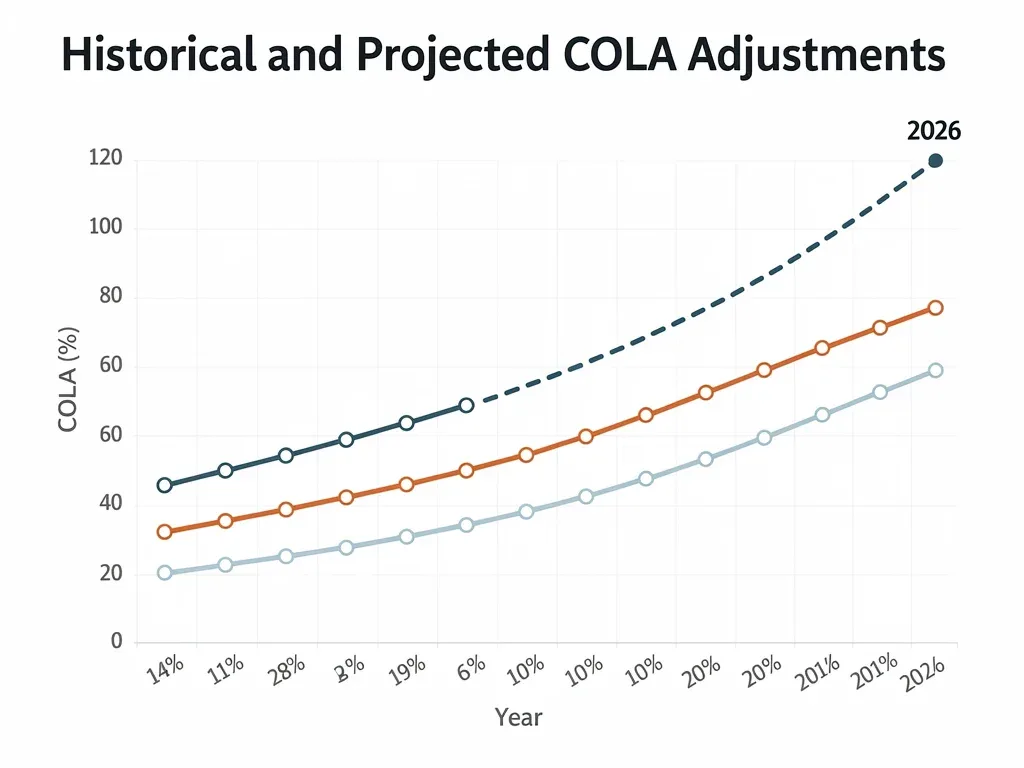
Periods of high inflation, such as the late 1970s and early 1980s, saw substantial COLA increases, sometimes in double digits. Conversely, periods of low inflation have resulted in much smaller or even zero adjustments, impacting beneficiaries' financial stability.
These historical patterns underscore the dynamic nature of the COLA and its direct link to economic conditions. The 2026 Social Security COLA adjustment will continue this trend, reflecting the prevailing economic climate of the time.
Lessons from Past COLA Outcomes
Past COLA outcomes teach us that predicting future adjustments with absolute certainty is impossible. Economic volatility, global events, and shifts in consumer behavior all contribute to the complexity of the forecast.
However, historical data does highlight the importance of the CPI-W as the primary driver. Understanding its components and how they typically react to economic shifts can offer a more informed perspective on 2026 Social Security COLA.
Beneficiaries should use historical data not as a definitive prediction, but as a guide to understanding the range of possibilities for the 2026 COLA. This perspective aids in flexible financial planning.
The Broader Economic Landscape for 2026
The economic landscape leading into 2026 will be a critical determinant for 2026 Social Security COLA. Global economic stability, domestic policy decisions, and labor market conditions will all play significant roles.
Experts are analyzing various scenarios, from continued moderate inflation to potential shifts in economic growth patterns. These broader trends directly influence the cost of living, which in turn impacts the COLA calculation.
Understanding these macro-economic forces is essential for comprehending the eventual 2026 Social Security COLA adjustment. The overall economic health of the nation dictates the environment in which benefits are adjusted.

How Global and Domestic Factors Intersect
Global supply chain issues, international trade policies, and geopolitical events can all influence domestic inflation rates. These external factors can create upward pressure on prices for goods and services, affecting the CPI-W.
Domestically, government spending, monetary policy decisions by the Federal Reserve, and employment rates also contribute to the inflationary environment. The interplay of these global and domestic elements creates the backdrop for 2026 Social Security COLA.
Beneficiaries should be aware that the COLA is not determined in a vacuum; it is a direct reflection of complex economic interactions. This holistic view helps in anticipating the adjustment.
Communication and Official Announcements from SSA
The Social Security Administration (SSA) is the official source for all COLA announcements. Typically, the announcement for the upcoming year's COLA occurs in October, providing beneficiaries with several months to prepare for the change.
The SSA communicates these adjustments through various channels, including their official website, press releases, and direct mail to beneficiaries. It is crucial for recipients to rely on these official sources for accurate and timely information.
Staying informed directly from the SSA ensures that beneficiaries have the most reliable data on 2026 Social Security COLA. Avoiding unofficial speculation is key to sound financial planning.
Accessing Your Social Security Statement
Beneficiaries can access their Social Security statements online through their mySocialSecurity account. This platform allows individuals to review their earnings history, estimated future benefits, and current benefit amounts, including any COLA adjustments.
Regularly checking your statement helps you verify that your benefits are accurate and reflect the latest COLA. This is an important step in managing your Social Security benefits effectively and understanding 2026 Social Security COLA.
The SSA's online tools are invaluable resources for beneficiaries seeking to understand their benefits. Utilizing these resources can provide clarity and peace of mind regarding future payouts.
Long-Term Implications of COLA Adjustments
The long-term implications of COLA adjustments extend beyond immediate monthly payouts, influencing overall retirement security and planning. Consistent adjustments, even small ones, compound over years, significantly impacting total lifetime benefits.
For those still planning for retirement, understanding the historical patterns and future projections of COLA can inform savings strategies and expected income streams. This foresight is critical for robust financial planning.
The cumulative effect of 2026 Social Security COLA, combined with future adjustments, shapes the long-term financial outlook for retirees. It underscores the importance of Social Security as a foundational income source.
COLA and Retirement Planning Longevity
A consistent COLA helps benefits keep pace with inflation over decades, which is vital for retirees living longer lives. Without these adjustments, the purchasing power of fixed benefits would diminish significantly, posing a challenge to financial longevity.
Considering the long-term impact of COLA adjustments is essential when projecting retirement expenses and income needs. It reinforces the necessity of a diversified retirement portfolio that complements Social Security benefits, especially when thinking about 2026 Social Security COLA.
Retirement planning should always factor in the dynamic nature of Social Security benefits, including the annual COLA. This comprehensive approach ensures greater financial resilience throughout retirement.
Key Point | Brief Description |
|---|---|
COLA Mechanism | Annual adjustment based on CPI-W to maintain purchasing power of benefits. |
Influencing Factors | Inflation trends, wage growth, and broader economic stability determine the adjustment. |
Payout Impact | Direct increase in monthly checks, affecting beneficiaries' budgets and financial planning. |
Preparation | Review budgets, monitor economic forecasts, and consult official SSA announcements. |
Frequently Asked Questions About the 2026 Social Security COLA
What is the primary factor determining the 2026 Social Security COLA?▼
The primary factor determining the 2026 Social Security COLA is the Consumer Price Index for Urban Wage Earners and Clerical Workers (CPI-W). This index measures inflation, and its changes directly influence the percentage of the annual adjustment, impacting How the 2026 Social Security COLA Adjustment Changes Your Monthly Benefit Payout.
When will the 2026 Social Security COLA be officially announced?▼
The Social Security Administration (SSA) typically announces the COLA for the upcoming year in October. For the 2026 COLA, beneficiaries can expect an official announcement in October 2025, detailing How the 2026 Social Security COLA Adjustment Changes Your Monthly Benefit Payout.
How will the 2026 COLA affect my monthly Social Security check?▼
Any COLA increase will be directly applied to your monthly Social Security benefit, resulting in a higher payout. The exact dollar amount will depend on your current benefit level and the announced COLA percentage, directly affecting How the 2026 Social Security COLA Adjustment Changes Your Monthly Benefit Payout.
What should beneficiaries do to prepare for the 2026 COLA?▼
Beneficiaries should review their current budgets, stay informed by monitoring economic news and official SSA announcements, and consider how potential COLA changes might impact their financial planning. This proactive approach helps in understanding How the 2026 Social Security COLA Adjustment Changes Your Monthly Benefit Payout.
Are there any scenarios where the 2026 COLA could be zero?▼
Yes, if the CPI-W does not show an increase between the third quarter of the current year and the third quarter of the previous year, the COLA could be zero. This scenario has occurred in the past during periods of extremely low inflation, impacting How the 2026 Social Security COLA Adjustment Changes Your Monthly Benefit Payout.
Looking Ahead: What This Means for Beneficiaries
The upcoming 2026 Social Security COLA adjustment is a critical development for millions of beneficiaries across the United States. While the precise percentage remains to be seen, understanding the underlying economic factors and the COLA mechanism is essential for informed financial planning.
Beneficiaries should continue to monitor inflation trends, official announcements from the Social Security Administration, and general economic indicators. These elements will collectively shape 2026 Social Security COLA, influencing household budgets and retirement security.
Proactive engagement with this information allows individuals to adjust their financial strategies, ensuring their Social Security benefits continue to support their cost of living effectively. The future of your monthly benefit payout hinges on these ongoing developments.